





Hyderabad Is Not One Market. It Is Several Markets Living Together
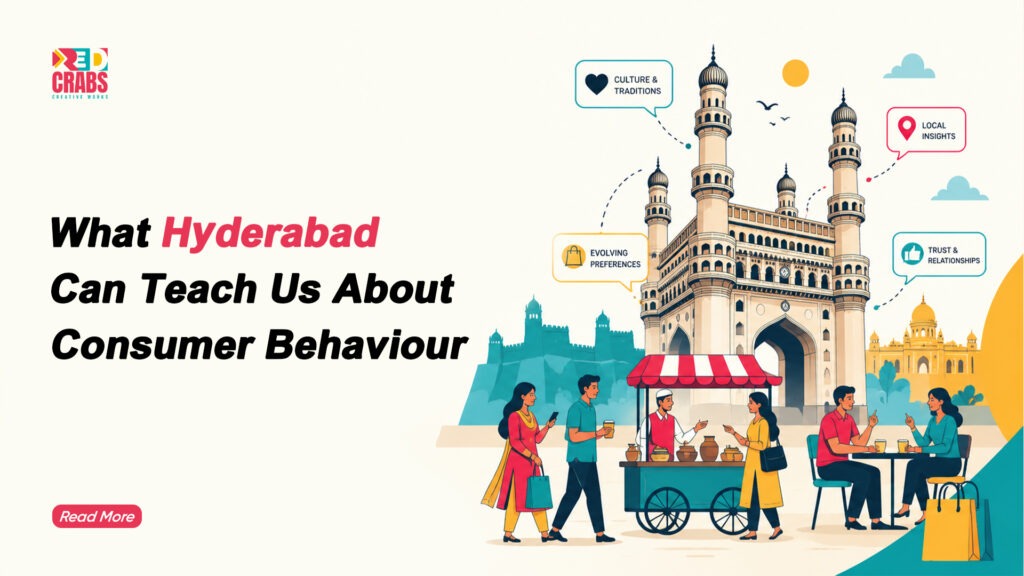
If you want to understand how people make buying decisions today, Hyderabad is an unusually interesting place to start. The city does not have one neat consumer profile that can be explained through age, income, profession, or neighbourhood. A software professional working in Gachibowli, a family shopping in Abids, a student spending an evening around DLF, a founder working out of HITEC City, and a household that has lived in the Old City for generations may all use the same digital platforms, yet have completely different ideas about what makes a product worth buying, which businesses deserve their trust, and how much they are willing to spend. Hyderabad is not one market behaving in one predictable way. It is a collection of different consumer environments constantly interacting with each other.
That makes Consumer behaviour in Hyderabad particularly interesting for marketers. The city has grown by layering new behaviours on top of existing ones rather than simply replacing the old with the new. Traditional family businesses operate alongside global companies. Neighbourhood markets exist alongside premium retail destinations. People who use food delivery apps still have strong opinions about restaurants they have known for years. Someone can discover a business through Instagram, check its reviews on Google, ask a friend for an opinion on WhatsApp, visit the physical location, and then return online to make the final decision. The customer journey has become a mixture of digital discovery, social validation, personal experience, and offline behaviour.
For a Digital marketing agency in Hyderabad, this creates a much more interesting challenge than deciding where an advertisement should appear. The real challenge is understanding what happens between awareness and action. A customer rarely sees an advertisement and immediately purchases. They notice a brand, become curious, compare it with alternatives, search for information, look for proof, consider the price, ask someone they trust, and sometimes leave the decision for later. Google describes this non-linear stage as the “messy middle”, where consumers repeatedly move between exploring options and evaluating them before feeling confident enough to make a choice. (Google)
India’s scale of digital adoption makes this behaviour even more important. DataReportal reported 806 million internet users in India in January 2025, representing internet penetration of 55.3%. That does not mean every purchase is made online, but it does mean digital information is increasingly part of how people discover and assess businesses. (DataReportal) For Hyderabad brands, the implication is significant: your customer may encounter you online even when the final transaction happens completely offline.
The Hyderabad Consumer Is More Contextual Than Demographic
One of the easiest mistakes in marketing is assuming that demographics explain consumer behaviour. They help identify who someone is, but they rarely explain why that person chooses one brand over another.
Consider two professionals in their early thirties who live in Hyderabad and earn similar salaries. One might happily spend ₹700 on dinner because the restaurant offers a social experience, atmosphere, convenience, and a sense that the occasion is worth spending on. The other may choose a ₹250 meal because they care more about portion size and familiarity. Both have similar demographic profiles, yet their buying behaviour is completely different.
The reason is that consumers do not have one universal definition of value. Value changes according to the category, situation, urgency, social setting, and emotional importance of the purchase. Someone who carefully compares grocery prices may have no problem paying a premium for a holiday. Someone who negotiates heavily when buying everyday products may spend significantly more on a phone because technology carries a different meaning for them. Someone may choose the cheapest available service in one category and the most trusted provider in another.
This is where marketers need to move beyond demographic targeting and start thinking about context. A consumer is not simply a 28-year-old professional living in Hyderabad. They are a 28-year-old professional choosing healthcare for a parent, looking for a restaurant for a date, buying a home for their family, selecting a course for their career, or searching for insurance after a major life event. The situation changes the decision.
This is why strong Local marketing strategies cannot simply mean adding Hyderabad-specific language to a campaign. Localisation is much deeper than geography. It means understanding the circumstances in which people make decisions and the cultural, social, and practical factors that influence those decisions.
Hyderabad Shows Why Word of Mouth Has Not Disappeared
It would be easy to assume that digital consumers have become less dependent on recommendations because they now have access to reviews, influencers, search engines, comparison platforms, and endless information. Hyderabad suggests something more interesting. Digital platforms have not eliminated word of mouth. They have given it more places to travel.
A recommendation that once moved from one friend to another can now appear in a WhatsApp group, an Instagram story, a Google review, a Reddit discussion, a creator’s video, or a neighbourhood community page. The medium has changed, but the psychological principle remains the same. People want evidence from other people before committing to a decision, particularly when the purchase carries risk.
Think about choosing a doctor. An advertisement can tell you what a hospital wants you to know. A friend’s recommendation answers a completely different question: “Would you actually trust this person with someone you care about?” The same principle applies to schools, builders, restaurants, insurance providers, salons, car workshops, and countless other businesses.
This is why social proof is not a decorative part of marketing. It can become part of the decision itself. Testimonials, reviews, customer stories, community recommendations, creator experiences, and referrals help reduce uncertainty because they allow a potential customer to borrow confidence from someone else’s experience.
For brands operating in Hyderabad, this creates an important opportunity. Instead of spending every marketing rupee telling customers how good the business is, some of that communication should demonstrate how other people experienced it. The shift from “we are trustworthy” to “here is evidence that people trust us” may appear small, but it changes the credibility of the message.
Hyderabad’s Food Culture Is a Lesson in Social Proof
Food offers one of the clearest examples of Customer buying behaviour because Hyderabad has a strong culture of recommendations, reputation, familiarity, and social experience around eating. A restaurant with a long queue is already communicating something before anyone reads its menu. The queue signals demand. Demand creates curiosity. Curiosity encourages trial. Once people start posting photographs, sharing recommendations, and talking about the restaurant, the social proof becomes even stronger.
The same mechanism works online. A restaurant with hundreds of reviews can feel safer than one with ten reviews, even if the average rating is similar. A café that repeatedly appears in people’s Instagram stories acquires a kind of cultural visibility that a traditional advertisement cannot easily manufacture. A friend sharing a restaurant location on WhatsApp provides a level of personal validation that a sponsored post cannot completely replicate.
What is interesting here is that none of these signals necessarily improve the food itself. They improve the customer’s confidence in the decision.
That distinction is useful far beyond the food category. A hospital with patient stories creates reassurance. A real estate developer with visible customer experiences creates confidence. An educational institution showing student outcomes provides evidence. An insurance brand explaining real customer situations can make an abstract financial product feel more understandable.
Consumers rarely evaluate the product in isolation. They evaluate everything surrounding the product because those surrounding signals help them decide whether the purchase feels safe, sensible, valuable, and socially validated.
Premium and Value Consumers Are Not Opposites
Hyderabad also demonstrates why the labels “premium consumer” and “budget consumer” can be misleading. The same individual can be highly price-conscious in one category and completely comfortable spending more in another. The difference is not necessarily income. It is perceived value.
A person may compare grocery prices across three stores but willingly spend more at a restaurant because the occasion matters. Someone may look for the cheapest flight but choose a premium hotel because the hotel experience is central to the trip. A customer may negotiate over a service fee but pay a premium for a provider they believe will eliminate risk.
This behaviour is important because brands often make the mistake of competing on price when the real opportunity is to communicate value more effectively.
A premium restaurant does not necessarily have to prove that every ingredient is better than every competitor’s ingredient. It needs to explain why the overall experience justifies the price. A premium healthcare provider needs to communicate not only medical capability but also trust, expertise, accessibility, and the confidence that comes from being in capable hands. A real estate brand selling at a premium needs to communicate why the location, infrastructure, community, design, and long-term value justify the difference.
Price is visible.
Perceived value is psychological.
That distinction sits at the centre of effective marketing.
Convenience Has Become a Form of Value
There is another consumer behaviour shift that is particularly relevant to a rapidly expanding city like Hyderabad: convenience has become something people are willing to pay for.
A customer may have several options available, but if one option is easier to discover, book, pay for, visit, return to, or communicate with, that convenience can become a deciding factor. This is especially relevant for professionals whose time has become one of their most limited resources.
A business can lose a customer without having a bad product simply because the buying process is unnecessarily difficult. If the website does not clearly explain the service, the customer has to search for basic information. If the price is difficult to understand, uncertainty increases. If booking requires multiple calls, the customer may choose a competitor offering a simpler process. If a business does not respond quickly to a query, the customer may assume the service itself will be equally difficult.
Convenience therefore communicates more than efficiency. It communicates consideration.
It tells customers that the business understands the value of their time.
This is why digital experience should not be treated as separate from marketing. A beautiful advertisement can create interest, but if the website, enquiry process, payment system, or customer support creates friction, the marketing investment can end up pushing customers toward a disappointing experience.
Why One Hyderabad Campaign Cannot Speak to Everyone
Hyderabad’s diversity makes generic local advertising particularly easy to spot. A campaign that appeals to young professionals in the Financial District may not resonate with families in established residential communities. Messaging built around speed and convenience may work well for one audience, while another may care much more about trust, reputation, and long-term relationships.
Even the meaning of a purchase can change between audiences.
For one person, a home is an investment.
For another, it is a family milestone.
For someone else, it represents social progress.
For a young professional, a premium café may simply be a place to meet friends. For a founder, it may become a work environment. For a student, it may be a social destination.
The product is the same.
The meaning is different.
This is why localisation should not mean simply using Hyderabad landmarks, local phrases, or city-specific references in advertisements. Those can make communication feel geographically relevant, but they do not necessarily make it behaviourally relevant.
True localisation happens when a customer sees a message and thinks, “This understands my situation.”
That is a much harder thing to achieve, but it is also much more valuable.
Hyderabad’s Growth Has Created a Strong Aspirational Layer
One of the most interesting dimensions of Consumer behaviour in Hyderabad is aspiration. The city has developed rapidly across technology, real estate, education, healthcare, hospitality, and entrepreneurship, creating an environment where consumers are not only buying for their present circumstances but often for the future they imagine.
This is particularly visible in categories such as homes, education, automobiles, technology, fitness, fashion, and premium experiences.
A person buying an apartment may not simply be buying square footage. They may be buying the idea of stability, independence, family life, or professional success. A student choosing an institution may not simply be purchasing an education. They may be buying a future career identity. A professional choosing a premium service may be communicating to themselves that their time has become valuable enough to justify paying for convenience.
This is why feature-heavy marketing can sometimes fail to connect. Features explain what a product has. Aspirational marketing explains what the product could mean in the customer’s life.
The strongest campaigns connect those two layers without exaggerating the promise.
They show the product, but they also show the life surrounding it.
The Bigger the Decision, the More Trust Matters
Not every purchase requires the same amount of research. Someone buying a snack may make a decision in seconds. Someone choosing a hospital, school, insurance provider, or home may spend weeks or months gathering information.
This creates what marketers often underestimate: a long period between interest and action.
A customer may discover a healthcare brand through an advertisement, visit its website, search for doctors, look at reviews, ask family members for opinions, compare alternatives, watch a video, and return to the website several times before finally making an appointment.
Google’s research into consumer decision-making shows that these journeys are rarely linear. Consumers move repeatedly between exploration, where they expand their options, and evaluation, where they narrow them down. (Google)
That changes what marketing needs to accomplish.
The purpose of an advertisement is not always to convert.
Sometimes its job is to create awareness.
A website may need to answer questions.
A testimonial may need to provide reassurance.
A video may need to make a complicated service easier to understand.
A review may provide the final piece of confidence.
Every touchpoint has a different role.
The mistake is expecting every piece of communication to perform the same job.
What Hyderabad Teaches Us About Local Marketing
The biggest lesson is that local marketing is not really about location. It is about context.
A good local campaign understands what people in a particular market value, but an excellent campaign goes one level deeper and understands why they value it.
That means studying how people discover brands, whom they trust, what they compare, where they hesitate, what they consider expensive, what they consider worthwhile, and what kind of evidence helps them feel confident.
For businesses, some of the most useful questions are surprisingly simple:
- What makes our customer hesitate before buying?
- What information do they search for before contacting us?
- Whose recommendation would they trust?
- What does “value” mean to them in this category?
- Which part of the buying process feels unnecessarily difficult?
- What would make choosing us feel safer?
- Are we communicating to the customer’s actual situation or simply describing our product?
These questions can produce stronger Local marketing strategies than another round of generic audience targeting.
What This Means for a Digital Marketing Agency in Hyderabad
For a Digital marketing agency in Hyderabad, understanding these behaviours changes the role of marketing completely. The job is not simply to create advertisements that generate impressions or social media posts that collect likes. The more valuable role is to understand the sequence of decisions happening between discovery and purchase and identify where a brand can create confidence.
Sometimes the answer is stronger content. Sometimes it is better social proof. Sometimes it is a clearer website. Sometimes it is simpler pricing. Sometimes it is a testimonial from the right customer. Sometimes the problem is not marketing at all, but a confusing customer experience that makes people hesitate after the marketing has already done its job.
This is where experience across industries becomes useful. At RedCrabs, working across different categories has shown us that the same marketing tactic can produce very different results depending on the customer’s situation. A healthcare audience may need reassurance, a real estate audience may need proof of long-term value, an education audience may need evidence of outcomes, and a consumer brand may need stronger social relevance. The platform can be the same. The psychology cannot. Digital Marketing
The strongest campaigns therefore do not begin with, “What should we post this month?”
They begin with a much harder question: “What is the customer trying to figure out?”
Once a brand can answer that, the content becomes easier to create because it has a purpose.
Hyderabad Is a Lesson in the Difference Between Selling and Understanding
Hyderabad’s consumer landscape ultimately teaches a lesson that extends far beyond the city. People do not buy simply because a business communicates its features well. They buy when the product fits their circumstances, the price feels justified, the brand appears trustworthy, the experience feels convenient, and enough evidence exists to make the decision feel safe.
Technology has changed how consumers discover businesses, but it has not eliminated the fundamental reasons people trust them. They still ask people they know. They still compare. They still look for proof. They still care about reputation. They still want value. They still want to feel that the decision they are making is the right one.
The difference is that consumers now have more tools to investigate those questions before making a purchase. A customer can challenge a brand’s claim within minutes. They can compare prices, read reviews, watch customer experiences, inspect locations, look at competitors, and search for alternatives without ever speaking to a salesperson.
That makes transparency increasingly valuable.
It also makes understanding increasingly important.
Brands that understand their customers’ behaviour can design better experiences because they know where uncertainty appears and what information can reduce it. Brands that only focus on visibility may generate attention without necessarily creating confidence.
Final Thoughts
Hyderabad is often described through its technology sector, food culture, expanding infrastructure, real estate growth, startups, and changing urban landscape. But there is another way to understand the city: as a fascinating case study in modern consumer behaviour.
It shows that tradition can coexist with digital adoption, that convenience does not eliminate the importance of relationships, that premium consumption can exist alongside intense price comparison, and that consumers can be highly digital while still relying heavily on family, community, reputation, and personal recommendations.
For brands, that is perhaps the most useful lesson.
The goal of marketing is not simply to make people notice you.
It is to understand what makes them choose you.
Once businesses start looking at marketing through that lens, Consumer behaviour in Hyderabad stops being a local observation and becomes a much broader lesson in how people make decisions. The strongest brands will not necessarily be the loudest ones. They will be the ones that understand their audience well enough to remove uncertainty, communicate value clearly, and show up meaningfully at the moments when decisions are actually being made.
If you want to turn those consumer insights into sharper Local marketing strategies, stronger digital campaigns, and marketing built around how people actually make decisions, work with RedCrabs Creative Works.