






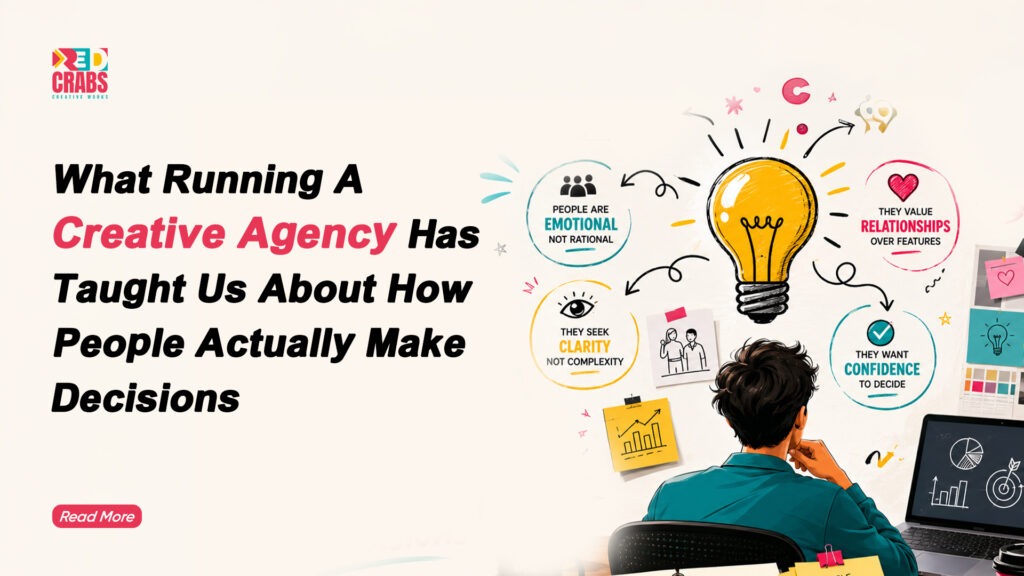
Marketing Looks Like Communication. Most of the Time, It Is Decision Support.
Running a creative agency changes the way you look at advertising. From the outside, marketing can seem fairly straightforward: understand the product, create something attractive, put it in front of the right audience, and wait for people to respond. Spend enough time working with different businesses, however, and that assumption starts to fall apart. The real challenge is rarely getting someone to see a brand. The harder challenge is understanding what happens after they see it, what questions start forming in their mind, what makes them hesitate, and what eventually gives them enough confidence to act.
Over the years, we have worked with an array of industries, including healthcare, education, insurance, real estate, technology, consumer brands, and professional services. The products and audiences may be completely different, but the patterns we see behind customer decisions are surprisingly similar. People want to know whether they can trust a business, whether the product is actually relevant to them, whether the price makes sense, whether other people have had a good experience, and whether choosing one option over another could come back to hurt them later. The category changes, but uncertainty remains one of the biggest things standing between interest and action.
That is probably one of the biggest things running an Online marketing agency has taught us. People are not simply deciding whether they want a product. They are constantly deciding whether they understand it, trust it, need it now, can justify the price, and feel confident enough to choose it over everything else available. That makes marketing much less about convincing someone and much more about helping them make sense of a decision.
This is where the Consumer decision-making process becomes important. Every advertisement, website page, social media post, testimonial, review, sales conversation, and customer experience can either move someone closer to confidence or create another reason to pause. The creative work may be what catches their attention, but everything that happens afterwards determines whether that attention turns into action.
People Rarely Buy the First Time They Discover You
One of the easiest assumptions to make in digital marketing is that awareness and conversion are closely connected. A person sees an advertisement, clicks on it, visits a website, and buys the product. That may happen occasionally, but it is hardly representative of how most considered purchases happen.
A customer may discover a brand on Instagram today and do absolutely nothing. A week later, they might see another post. A month later, someone they know might mention the company. They may then search for reviews, compare competitors, look at pricing, visit the website, leave, return several days later, and finally enquire when the need becomes more urgent.
From the brand’s perspective, these interactions can look disconnected. From the customer’s perspective, they are all part of the same decision.
Google’s research describes the modern purchase journey as a “messy middle”, where consumers move between exploring options and evaluating them before finally making a decision. (Google)
That has changed the way we look at performance. A social media post that does not generate an immediate enquiry has not necessarily failed. It may have introduced the brand to someone who becomes a customer months later. A testimonial may not produce a direct conversion, but it may become the piece of evidence that reassures someone who has already been researching the company.
Not every piece of marketing has to close the sale.
Some pieces simply need to make the next decision easier.
The Better Question Is Not “Will They Buy?” but “Why Are They Hesitating?”
When a campaign underperforms, the first instinct is usually to change the creative.
Change the headline.
Change the visual.
Change the offer.
Increase the ad budget.
Try a different platform.
Sometimes those changes are necessary. But after working across different industries, we have learned that poor performance is often caused by something much deeper. The advertisement may actually be doing its job. The problem may be somewhere else in the Customer decision journey.
A customer may be thinking:
- Is this actually worth the price?
- Can I trust this company?
- Will this work for someone like me?
- Why should I choose this instead of the cheaper option?
- What happens after I pay?
- Is this a genuine offer?
- What happens if something goes wrong?
- Do I actually need this right now?
These questions rarely appear neatly inside an analytics dashboard, but they can determine whether someone converts.
This is where Marketing psychology becomes useful. It is not about manipulating people into buying something they do not want. It is about understanding the motivations, doubts, expectations, mental shortcuts, and emotional factors that influence decisions so brands can communicate more clearly.
Sometimes the strongest campaign improvement is not a better advertisement.
It is a better answer to a question the customer already has.
People Are Constantly Looking for Signals That Reduce Risk
Every purchase involves some level of uncertainty.
The uncertainty may be financial, emotional, practical, or social.
Buying a ₹200 product usually involves very little perceived risk. Choosing a hospital, purchasing insurance, selecting a college, buying a house, or hiring a professional service involves considerably more.
As the perceived risk increases, people tend to look for more evidence.
They search for reviews.
They ask friends.
They look at testimonials.
They compare alternatives.
They investigate the company.
They look at the people behind the business.
They want to know what happens if something goes wrong.
That is why trust signals become increasingly important as the value or perceived risk of a purchase increases.
Nielsen’s research has repeatedly found that recommendations from people consumers know are among the most trusted forms of advertising. In its 2012 India study, recommendations from friends and family were trusted by 91% of respondents, while online consumer reviews were trusted by 77%. (Nielsen)
That helps explain why a genuine customer testimonial can sometimes outperform a beautifully produced advertisement. The advertisement says, “We are good.” The customer says, “I experienced this.”
One is a claim.
The other is evidence.
For businesses, that difference matters.
The Cheapest Option Does Not Always Win
Another lesson you learn quickly when working across industries is that customers rarely choose purely based on price.
If price were the only factor, the cheapest business in every category would dominate the market.
It does not.
People constantly trade money against other forms of value, including convenience, trust, quality, speed, experience, status, reliability, and reduced risk.
Someone may spend more at a restaurant because they trust the quality. Someone may choose a more expensive hospital because the doctors have a stronger reputation. A business may pay more for a service because it believes the provider will require less supervision. A customer may buy a premium product because it reflects the identity they want to project.
This is why perceived value can matter more than absolute price.
A ₹10,000 service can feel expensive when the customer does not understand what they are receiving. The same service can feel reasonable when the outcome, expertise, process, and expected value are clearly communicated.
Good marketing therefore does not simply justify price.
It explains value.
More Choice Does Not Always Mean Better Decisions
Digital platforms have made comparison incredibly easy. A customer can open multiple tabs, compare prices, read reviews, watch videos, check social media, look at alternatives, and research competitors within minutes.
That is undoubtedly useful.
But too much choice can also make decisions harder.
Imagine someone searching for health insurance and finding dozens of policies with different premiums, exclusions, waiting periods, add-ons, and coverage levels. More options do not necessarily create more confidence. They can create decision fatigue.
The same thing happens when a website offers ten service packages without explaining which one is appropriate for which customer.
The business believes it is giving people flexibility.
The customer experiences uncertainty.
This is why one of the most useful principles we have learned through agency work is that good marketing often simplifies rather than adds. The goal is not to tell customers everything at once. It is to give them the information they need at the point when they need it.
That could mean highlighting three important benefits instead of fifteen features. It could mean comparing two packages instead of presenting six. It could mean answering the five questions customers repeatedly ask the sales team instead of filling the website with generic information.
Clarity is not about saying less for the sake of saying less.
It is about making the important things easier to understand.
Simplicity Is a Creative Skill
Simplicity sounds easy until you have to achieve it.
Anyone can add more information.
Removing information requires judgment.
A brand may have fifteen product features, but only three may matter during the initial decision. A healthcare institution may offer dozens of services, but a potential patient may primarily need to know which specialist they should consult. An education brand may have hundreds of facilities, but a parent may mainly want evidence of faculty quality, outcomes, safety, and career opportunities.
Creative teams are often brought in to make information look better.
The better role is to make information easier to understand.
That is a significant difference.
Design is not simply decoration. Copy is not simply wording. Video is not simply entertainment. Each format can reduce cognitive effort when it is designed around the questions people actually have.
When a complicated decision feels simpler, people become more comfortable moving forward.
The Customer Journey Is Full of Invisible Moments
One of the most useful things we have learned from working on campaigns is that customers experience dozens of moments that brands never see.
A person might hesitate before clicking an advertisement because the offer feels too good to be true.
They might visit a website and leave because the information is confusing.
They might return later but hesitate because there are no reviews.
They might finally enquire but delay the purchase because nobody explains what happens next.
They might compare a competitor and choose them because their website answers one question your website ignored.
None of these moments necessarily appears as one obvious problem. Together, however, they can determine the outcome.
This is why mapping the Customer decision journey is so valuable. Instead of looking only at the final conversion, marketers can examine the entire experience from the first interaction to the final decision and even the post-purchase stage.
At each stage, the question becomes:
What does the customer need to understand, believe, or feel before moving forward?
That question can reveal more than simply asking why conversions are low.
People Do Not Always Want More Information. They Want the Right Information.
A common response to poor conversion is to add more content.
More blogs.
More FAQs.
More product pages.
More videos.
More testimonials.
More features.
But more information does not automatically solve uncertainty. Sometimes it creates more of it.
A customer looking for a simple answer should not have to read a long explanation before finding it. Someone comparing two services should not need to contact sales just to understand the basic difference. A person interested in a product should not have to search through multiple pages to find the price, process, or next step.
The strongest brands organise information around customer questions rather than internal organisational structures.
Instead of saying, “Here are all the things we want customers to know,” they ask, “What does someone need to know to confidently make this decision?”
That produces much stronger content.
This Is Why Data Alone Cannot Explain Everything
Modern marketers have access to an extraordinary amount of information. We can see impressions, clicks, watch time, engagement rates, bounce rates, conversion rates, traffic sources, and audience demographics.
These metrics are extremely useful.
But they do not always explain why someone behaved a certain way.
A high bounce rate may mean the page is poor. It could also mean the visitor found exactly what they needed and left.
A low click-through rate may indicate weak creative. It could also mean the audience was not ready to act.
A high engagement rate may indicate strong content. It could also indicate that the content is entertaining but completely unrelated to the product.
Numbers tell us what happened.
Human understanding helps us investigate why.
This is one reason the strongest agency teams combine performance data with qualitative observation. Analytics can identify where a problem exists. Conversations with customers, sales teams, client teams, and actual users can help explain why it exists.
The Best Marketing Often Removes a Fear
After working across different categories, one pattern becomes increasingly difficult to ignore. Customers are rarely asking only, “What do I get?”
They are also asking, “What could go wrong?”
This becomes particularly obvious in categories involving money, health, education, property, insurance, and long-term commitments.
A customer buying insurance may fear discovering an exclusion later.
A patient may fear choosing the wrong doctor.
A parent may fear choosing the wrong educational institution.
A homeowner may fear hidden costs.
A business hiring an agency may fear paying for activity without seeing meaningful outcomes.
These fears may not appear in product descriptions, but they influence decisions.
A strong campaign does not necessarily need to mention every fear directly. Sometimes it simply needs to provide enough clarity and evidence to reduce uncertainty.
That could mean transparent pricing.
It could mean genuine customer testimonials.
It could mean explaining the process.
It could mean showing the people behind the service.
It could mean acknowledging a common concern instead of pretending it does not exist.
Trust often begins when a brand demonstrates that it understands what the customer is worried about.
Creativity Works Best When It Solves a Decision Problem
This has changed the way we think about creative work.
A creative idea should not exist simply because it looks interesting.
It should solve something.
It might make a complicated product easier to understand. It might make an unfamiliar brand feel trustworthy. It might give a customer language for a problem they have struggled to explain. It might turn an abstract benefit into something tangible. It might make a brand more memorable at the exact point when someone is comparing alternatives.
That is where creativity and strategy become inseparable.
The best creative work is not always the loudest.
Sometimes it is the clearest.
Sometimes it is the most reassuring.
Sometimes it asks the exact question the customer was already asking themselves.
That is a much deeper definition of creativity than simply making something visually attractive.
What Working Across Industries Has Taught Us
Over the years, we have worked with an array of industries, from healthcare and education to insurance, real estate, technology, and consumer-focused businesses. What makes that experience valuable is not just the variety of brands we have worked with, but the patterns we start noticing across them. The products may be completely different, the audiences may have different priorities, and the buying cycles may vary significantly, but the underlying questions customers ask are surprisingly similar. Can I trust this brand? Is this actually worth the money? Will this work for someone like me? What happens after I make the decision? How do I know I am choosing the right option?
Working across these different industries has shown us that there is rarely a single formula for getting people to convert. A healthcare brand cannot communicate in the same way as a real estate brand, and an insurance company cannot approach its audience like a consumer lifestyle brand. The context changes, the level of risk changes, and the customer’s emotional state changes. But the need for clarity, trust, relevance, and reassurance remains. That is where our experience as an Online Marketing Agency has shaped the way we approach creative and digital marketing. We have learned to look beyond the campaign itself and understand what the customer is actually trying to figure out before making a decision.
That experience has also taught us not to treat every performance problem as a content problem. Sometimes the creative needs to change. Sometimes the messaging is unclear. Sometimes the customer journey has too much friction. Sometimes the brand has not given people enough reason to trust it. And sometimes the audience simply is not ready to make the decision yet. Having worked across an array of industries has helped us recognise these differences much faster and build communication around the actual problem rather than automatically reaching for another campaign.
This is also why we see creativity and strategy as closely connected. Good creative work should not just make a brand look better. It should make something easier to understand, make a complicated decision feel simpler, answer an objection, build confidence, or give people a reason to remember the brand when they are finally ready to choose. After working across different industries and audiences, we have found that the strongest work usually starts with understanding people first and creating for them second.
AI Is Changing Execution, but Human Judgment Still Matters
The rise of AI is making this understanding even more important.
AI can generate headlines, analyse large amounts of information, summarise research, identify patterns, produce content variations, and accelerate production. Those capabilities can make marketing teams significantly faster.
But speed does not automatically produce better decisions.
A tool can generate ten campaign concepts. Someone still has to decide which one actually fits the brand.
A system can analyse customer reviews. Someone still has to understand the emotional issue behind them.
A model can create hundreds of versions of an advertisement. Someone still needs to determine which message is appropriate for the audience.
The more content becomes automated, the more valuable judgment becomes.
That is another reason Marketing psychology cannot simply be replaced by better technology. Understanding why people behave the way they do requires context, observation, empathy, and interpretation.
Technology can help us process information.
People still have to decide what the information means.
The Most Important Decision May Be the One You Never See
When marketers talk about conversion, they usually focus on the final action.
The purchase.
The booking.
The enquiry.
The sign-up.
But there are dozens of smaller decisions leading to that point.
The decision to stop scrolling.
The decision to click.
The decision to trust the website.
The decision to read another page.
The decision to compare.
The decision to return.
The decision to ask someone.
The decision to believe the testimonial.
The decision to finally enquire.
Each one is small.
Together, they create the customer journey.
That is why the Consumer decision-making process should not be treated as something that happens at the end of marketing. It is happening throughout the entire experience.
Every touchpoint is participating in the decision.
What This Means for Brands Today
If there is one lesson running a creative agency has taught us, it is that brands often spend too much time asking how to attract attention and not enough time asking what happens after they have it.
Attention is only the beginning.
Once someone notices a brand, the brand has to answer a series of increasingly important questions: Can I trust you? Do you understand what I need? Is this worth the money? Are other people choosing you? Is the process going to be easy? What happens if something goes wrong? Why should I choose you instead of the alternative?
The strongest marketing systems are built around these questions.
That means:
- Creative should create interest.
- Content should create understanding.
- Social proof should create confidence.
- Websites should remove friction.
- Sales conversations should resolve remaining uncertainty.
- Customer experiences should confirm the promise.
When these elements work together, marketing stops feeling like a series of disconnected campaigns and starts functioning as one continuous decision-support system.
Final Thoughts
Running a creative agency has taught us that people are far less predictable than a marketing dashboard can make them appear. Customers do not always follow the path brands expect. They hesitate for reasons that may never appear in analytics, compare things marketers assume are unrelated, seek reassurance from people they trust, and sometimes take weeks to make a decision that a business expected them to make in minutes.
The answer is not to manipulate that behaviour.
It is to understand it.
The most effective marketing respects the customer’s decision-making process instead of trying to force it. It gives people enough clarity to understand their options, enough evidence to trust the brand, and enough confidence to take the next step.
That is why the future of marketing will not simply belong to businesses that can create the most content or generate the most impressions. It will belong to businesses that understand what happens inside the customer’s mind between “I’ve seen this” and “I’m ready to choose this.”
For brands looking to understand that journey more deeply and turn consumer insight into stronger creative and digital marketing, work with RedCrabs Creative Works to build a strategy around the decisions your customers are actually trying to make.