






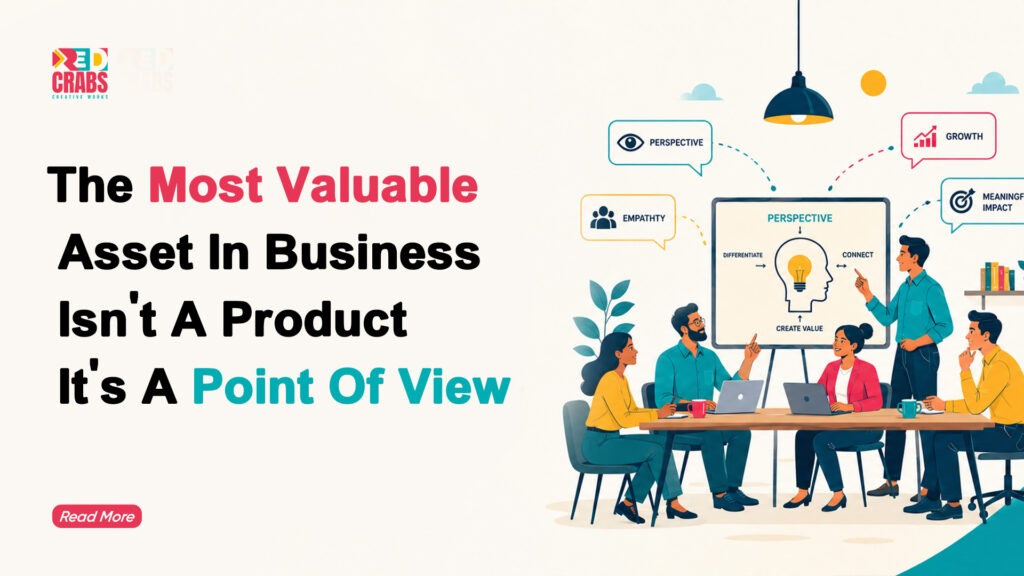
Products Can Be Copied. Perspective Is Harder to Replace
Businesses spend years developing products, improving features, studying competitors, and finding ways to make their offerings more attractive. All of that matters, but there is another asset that often gets overlooked: what the business actually believes.
A product can be copied. A feature can be replicated. A pricing model can be matched. Even a successful campaign can be recreated. What is much harder to copy is the way a business understands its industry, interprets customer problems, and chooses to approach them differently.
Think about brands people recognise almost instantly. Their products matter, but there is usually something bigger attached to them. Apple has built strong associations around simplicity and design. Patagonia has connected its products with environmental responsibility. IKEA has built a perspective around making functional design accessible.
The product gives people something to buy. The point of view gives them a reason to remember the brand.
For businesses investing in Best digital marketing services, this distinction matters more than ever. Digital platforms have made it easier for brands to communicate, but they have also made it incredibly easy for businesses to sound identical. Everyone is innovative. Everyone is customer-centric. Everyone offers solutions. Everyone is transforming industries.
The question is no longer simply, “What do we sell?”
It is “What do we believe about the problem we are solving?”
A Point of View Is More Than an Opinion
A business point of view is not about being controversial on LinkedIn or taking an unpopular position just to generate engagement. It is a consistent way of seeing the market.
A healthcare brand might believe that prevention deserves more attention than treatment. An insurance company might believe customers should understand their coverage before purchasing it. An education brand might believe academic learning should be connected more closely with employability. A technology company might believe technology should make people’s lives simpler rather than more complicated.
Once that belief becomes clear, it can influence much more than content.
It can influence:
- What products the business develops
- How it communicates
- What customers it attracts
- Which opportunities it accepts
- Which trends it ignores
- How its team makes decisions
- What experience customers receive
That is when a point of view becomes a business asset rather than a marketing statement.
Why a Good Product Is No Longer Enough
Consumers have more options than ever before. They can compare products, read reviews, watch demonstrations, check competitors, ask friends, and research alternatives before making a decision.
This has made Brand differentiation much harder.
If ten companies offer similar products at similar prices, simply saying “we provide quality” is not enough. The customer needs another reason to remember you.
That reason could be convenience, expertise, trust, experience, reputation, or a perspective that feels relevant to them.
This is why a strong Brand positioning strategy should not begin with a tagline. It should begin with questions such as:
What do we understand better than our competitors?
What do we believe should change in our industry?
What problem are we willing to solve differently?
What can we consistently stand for?
The answers create the foundation for everything that comes afterwards.
The Problem With “We Are Different”
Almost every business wants to position itself as different. The problem is that most brands describe their difference using the same language.
“Innovative solutions.”
“Customer-first.”
“Trusted quality.”
“Next-generation technology.”
“End-to-end solutions.”
These phrases are not necessarily false. They are simply too broad to create meaningful distinction.
Real differentiation becomes stronger when a brand can explain why it approaches something differently.
An insurance brand saying “we simplify insurance” is still fairly generic. A brand that consistently believes customers should understand what they are buying before they are asked to purchase it has a much stronger foundation for communication.
A real estate company saying “we build quality homes” sounds familiar. A company that believes residential design should improve everyday family life gives itself a more distinctive perspective.
The difference is between making a claim and owning an idea.
Your Point of View Should Influence What You Do
A useful test for any positioning is simple: does it actually change the way the business operates?
If a company claims to value simplicity but keeps making its products more complicated, customers will eventually notice.
If a business says it believes in transparency but hides important pricing information, the positioning loses credibility.
If a brand claims to put customers first but makes its support process frustrating, no campaign can permanently fix that contradiction.
A strong point of view creates boundaries. It tells a business not only what to do, but what not to do.
That is incredibly valuable when a company is growing and facing hundreds of decisions around products, campaigns, partnerships, content, pricing, and customer experience.
Thought Leadership Is About Giving People Something to Think About
This is where Thought leadership marketing becomes more valuable than simply publishing more content.
Thought leadership is not posting three LinkedIn articles every week and calling the company a thought leader. It is about contributing a perspective that helps people understand an issue differently.
For example, a cybersecurity company can spend its entire content strategy talking about security features. Or it can argue that cybersecurity should be treated as a business continuity issue rather than simply an IT responsibility.
The second approach gives the company something to own.
It creates conversation.
It gives the audience a reason to remember the business beyond its product.
This is especially important now because AI has made content production dramatically easier. Businesses can generate articles, captions, ideas, summaries, and variations at a speed that was difficult to imagine a few years ago.
As content becomes easier to produce, having something meaningful to say becomes more valuable.
Information is becoming abundant.
Interpretation is becoming scarce.
We See This Across the Industries We Work With
We have worked with an array of industries, from healthcare and education to insurance, technology, real estate, and consumer-focused businesses. One of the biggest things that experience has shown us is that the strongest brands are rarely the ones trying hardest to appear different.
They usually know what they want to be known for.
A healthcare organisation might own a perspective around accessible care. An education institution might have a clear belief about preparing students for the real world. An insurance business might want to make financial protection easier to understand. A technology company might build its identity around simplifying complex systems.
The industries are completely different, but the principle remains the same.
When a brand has a clear perspective, its content becomes easier to create because there is something behind the content.
At RedCrabs, working across these industries has also taught us that brands often do not need more content. They need a clearer reason for creating it. Once the positioning is clear, the creative direction, messaging, campaigns, and digital communication start becoming much more focused. That is where Best Digital Marketing Services should go beyond execution and help a business build a position it can actually own.
Your Customers May Already Be Telling You What Your Point of View Is
A point of view does not always have to be invented in a strategy meeting. Sometimes your customers are already showing you what it should be.
Look at the questions they repeatedly ask.
Look at the problems they complain about.
Look at what your sales team constantly has to explain.
Look at why customers choose you instead of competitors.
Look at the language they use in reviews.
These patterns can reveal something valuable.
Suppose customers repeatedly tell an insurance company, “Nobody ever explained this to me properly.” That is not just feedback. It could reveal an opportunity to build a brand around clarity.
Suppose patients repeatedly say they struggled to understand which specialist they needed. That could become a healthcare brand’s opportunity to own the idea of easier healthcare navigation.
Suppose clients repeatedly tell an agency, “We were creating content but had no idea why we were creating it.” That insight can become a point of view around strategy-led marketing rather than content for the sake of content.
Sometimes the strongest positioning is already sitting inside the customer conversations.
A Strong Point of View Can Become a Competitive Moat
Imagine two consulting companies offering similar services.
One says:
“We help businesses improve performance.”
The other says:
“Most businesses don’t have a productivity problem. They have a decision-making problem.”
The second statement creates curiosity because it gives the audience something to think about. You might agree with it, disagree with it, or want to understand it, but you are more likely to remember it.
That is the power of perspective.
Over time, if the company consistently publishes ideas around that belief, demonstrates it through its work, and helps customers understand their problems differently, the association becomes stronger.
Competitors can copy a phrase.
They cannot instantly copy the credibility built around that phrase.
That is when a point of view becomes a competitive asset.
The Goal Isn’t to Be Controversial. It’s to Be Recognisable
There is a tendency online to think that brands need to be provocative to have a point of view. They do not.
A strong perspective can be simple.
It can challenge an assumption without creating unnecessary controversy. It can explain something people have misunderstood for years. It can give customers a better way to think about a familiar problem.
The real test is whether the audience starts recognising the way the business thinks.
If you remove the logo from a piece of content, could someone still tell which brand created it?
If the answer is yes because of the thinking, not just the colours and fonts, the brand is building something valuable.
That is a much deeper level of recognition than visual identity alone.
From Point of View to Reputation
One post does not create thought leadership.
One campaign does not create differentiation.
One strong opinion does not create positioning.
Consistency does.
When a company repeatedly talks about a particular problem, demonstrates expertise around it, develops its offerings with that perspective in mind, and creates customer experiences that reinforce the same belief, the market starts connecting the company with that idea.
Eventually, the brand does not have to explain itself every time.
People already know what it stands for.
That is when positioning becomes reputation.
And reputation is much harder to copy.
A Point of View Can Give a Brand Direction
This is perhaps the most practical reason businesses need a point of view.
Marketing teams are constantly being asked what to post next, what campaign to run, what trend to follow, what audience to target, and what message to push.
Without a clear perspective, every new trend can feel like an opportunity.
With a clear perspective, there is a filter.
A business can ask:
- Does this idea fit what we believe?
- Does it strengthen what we want to be known for?
- Does it help our audience understand something better?
- Does it sound like us?
- Does it reinforce our position or dilute it?
That makes decision-making easier.
It also makes the brand more consistent without making the content repetitive.
Final Thoughts
The most valuable asset in a business may not always be the product sitting on the shelf or the service listed on the website. It may be the perspective that sits behind everything the business does.
Products evolve. Competitors catch up. Features become standard. Technology changes. New platforms appear. Consumer expectations move.
A strong point of view gives a business something to hold onto while everything around it changes.
The strongest brands do not only ask, “How can we be different?”
They ask, “What do we see differently?”
That question can lead to stronger Brand differentiation, more meaningful Thought leadership marketing, clearer communication, and a more recognisable position in the market.
Because a product can be copied.
A campaign can be copied.
A trend can be copied.
But a point of view built through experience, expressed consistently, and proven through action is much harder to replace.
If your business has expertise worth owning but has not yet turned it into a clear market position, work with RedCrabs Creative Works to build a stronger Brand positioning strategy, content direction, and digital presence.