







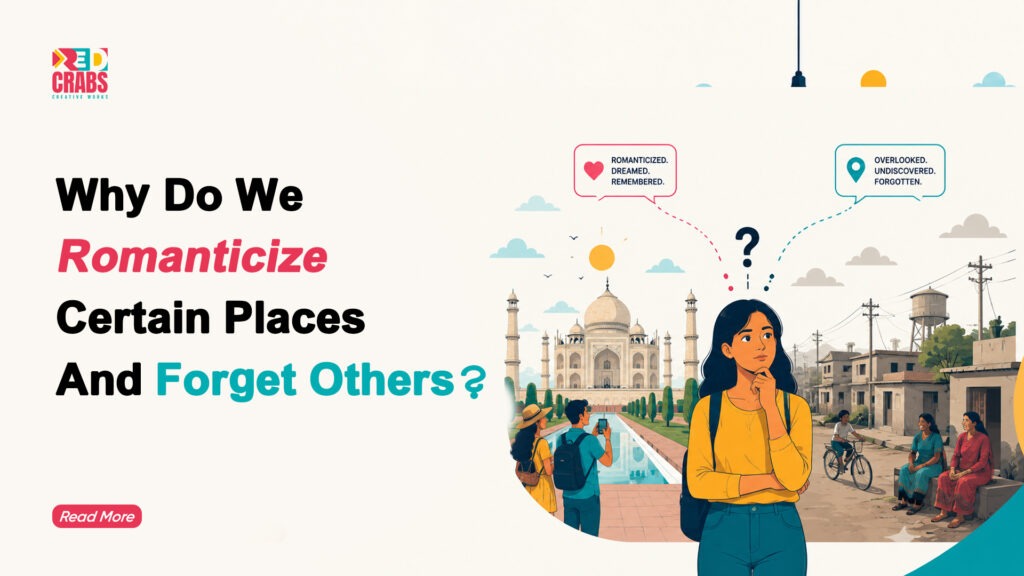
Some Places Become Memories. Others Are Just Locations.
Think about a place you have never visited but somehow already feel familiar with. Maybe it is a café you have seen repeatedly on Instagram, a street you associate with a particular kind of evening, a neighbourhood everyone seems to talk about, or a city you have built an entire image of without ever spending more than a few days there.
Now think about another place you have actually visited but barely remember.
Both places existed physically. Both had buildings, roads, shops, people, and experiences. Yet one stayed with you while the other disappeared almost immediately.
That difference is what makes Place branding so interesting.
People do not remember places purely because of what they look like. They remember what those places came to represent. A location can become associated with romance, ambition, freedom, nostalgia, luxury, creativity, belonging, or a particular stage of someone’s life. Once that association becomes strong enough, the place stops being just a physical location and becomes an idea in the person’s mind.
This is why two cafés on the same street can create completely different emotional responses. It is why some neighbourhoods become destinations while others remain places people simply pass through. It is also why cities invest so much effort into how they present themselves to visitors, residents, businesses, and investors.
The interesting question is not simply why some places look better.
It is why do some places mean more to us?
We Rarely Remember Places Exactly as They Were
Memory is not a perfect recording of reality. We tend to remember experiences through emotions, moments, people, sensory details, and the meaning we attached to them.
Think about a holiday you took years ago. You probably cannot remember every street you walked through or every meal you ate. But you may vividly remember sitting somewhere at sunset, getting lost with friends, hearing a particular song, or eating something that felt special at the time.
The place becomes attached to the emotion.
That is why nostalgia can be so powerful in marketing. A physical location can become a container for memories, and when brands communicate around those memories, they are not simply selling the location. They are activating an existing emotional association.
A coffee shop does not necessarily become memorable because its chairs are better. It becomes memorable because someone associates it with late-night conversations, first dates, studying with friends, weekend routines, or a particular period of their life.
The physical space creates the setting.
The person creates the meaning.
Hyderabad Is a Great Example of This
Hyderabad itself demonstrates how emotional associations can shape the way people experience places.
Ask different people what Hyderabad means to them and you will get completely different answers. For some, it is Charminar, biryani, old markets, family memories, and familiar streets. For others, it is HITEC City, corporate life, startups, cafés, new apartments, and professional ambition. Someone else may associate the city with college years, friendships, nightlife, or moving away from home for the first time.
None of these descriptions is incorrect.
They are different emotional versions of the same city.
This is where Place branding becomes much more complex than designing a logo for a city or creating a tourism campaign. A place already has stories attached to it. The challenge is understanding which stories exist, which ones people identify with, and which new associations a place wants to build.
A city cannot completely manufacture how people feel about it.
But it can influence the stories people encounter repeatedly.
Why Hyderabad’s Cafés Are a Perfect Example
Walk around Banjara Hills or Jubilee Hills and you will notice something interesting. There is no shortage of cafés that look good. Beautiful interiors, carefully designed menus, statement furniture, mood lighting, open kitchens, curated playlists, photogenic desserts, and spaces that seem almost designed with Instagram in mind have become part of the city’s café culture.
Yet even with so many cafés offering a visually appealing experience, only a few become the places people actively remember and recommend.
That is because people are rarely choosing a café only because the coffee is good or the interiors look expensive. They are choosing the feeling attached to the place. One café might feel like a weekend brunch destination. Another might feel like a place to dress up and meet friends. Another might become the regular work café. Another might be associated with dates, birthdays, late-night conversations, or simply being in a particular part of the city.
This is where Place branding becomes visible in everyday life. Banjara Hills and Jubilee Hills have developed strong associations with premium dining, cafés, nightlife, fashion, and a particular urban lifestyle. A new café entering that environment is therefore not simply competing on food and ambience. It is competing against the existing meaning of the neighbourhood and the expectations people already have when they enter it.
And that is why two cafés with equally beautiful interiors can have completely different levels of recall. One becomes, “That café with the really nice interiors.” The other becomes, “That is the place we always go to on Sunday mornings.” The second has crossed an important line. It has moved from being a location to becoming part of someone’s routine and memory.
The interesting part is that this does not always happen because one café has dramatically better marketing. Sometimes it happens because the experience, visual identity, audience, location, social atmosphere, and online presence all reinforce the same feeling. People know what kind of experience they are likely to have before they even arrive.
That is Emotional branding working at a very local level. The café is not simply selling coffee or food. It is selling a version of an evening, a weekend, a social experience, or even a lifestyle.
Why Some Cafés Become “The Place”
The café culture around Banjara Hills and Jubilee Hills also shows why visibility alone is not enough. A new café can generate thousands of views when it opens, especially when creators and influencers visit during the launch. But attention can disappear quickly if people do not develop a reason to return.
The cafés that become memorable usually develop a recognisable personality. Maybe it is the kind of crowd they attract, the music, the menu, the interiors, the service, the location, or simply the feeling people associate with spending time there. Once customers begin attaching their own memories to the space, the brand becomes stronger than its physical interiors.
Someone may not remember exactly what they ordered six months later. They may remember who they were with, what they talked about, how the evening felt, or what happened afterwards. They remember where it happened.
That is when a café becomes more than a café.
It becomes a memory cue.
This is also why simply making every new café look “premium” is not enough. When every space has marble tables, warm lighting, plants, oversized mirrors, designer chairs, and photogenic plating, those visual elements stop being distinctive. The challenge becomes creating an experience that has its own personality rather than simply matching the visual language of every other premium café in the neighbourhood.
For a Digital marketing company in Hyderabad, this changes the way a café or hospitality brand should be marketed. The question should not only be, “How do we make people visit?” It should be, “What do we want people to say about this place after they leave?”
That answer can shape everything from content and photography to influencer collaborations, offers, storytelling, and the way the brand presents itself online.
The Psychology Behind Why We Remember Some Places
This is where Brand recall psychology becomes useful.
Our brains do not treat every piece of information equally. We are more likely to remember experiences that are emotionally significant, distinctive, repeated, or connected to something we already know.
That explains why an ordinary-looking street can become unforgettable if something meaningful happened there.
The street itself may not be remarkable.
The memory attached to it is.
Brands operate in a similar way. When a business becomes associated with a particular emotion or moment, remembering the brand becomes easier because the brand is no longer just a name. It is connected to something meaningful.
This is one reason distinctive sensory experiences can be so powerful. A particular smell, song, visual style, phrase, colour, packaging style, or even the way a space feels can become a cue that brings the experience back to mind.
Research into the psychology of memory has long shown that emotionally significant experiences can be remembered differently from ordinary information, which helps explain why emotion plays such an important role in what stays with us. (APA)
We Romanticize What We Associate With a Feeling
People often say they miss a particular place when what they actually miss is how they felt when they were there.
Someone may say, “I miss college.”
But they may actually miss independence, friendships, late nights, fewer responsibilities, or the feeling that life was just beginning.
Someone may say, “That café was so special.”
But the emotional attachment may come from the people they were with rather than the coffee.
Someone may say, “I love that part of Hyderabad.”
But the attachment may come from years of family memories, routines, and familiarity.
This distinction is extremely important for brands.
If you want people to remember a place, simply showing the place may not be enough.
You have to understand what the place represents.
This Is Why Tourism Marketing Can Feel So Similar
Look at how cities and destinations are often marketed.
Beautiful sunsets.
Beautiful architecture.
Food.
Hotels.
Landmarks.
People having a great time.
These visuals are attractive, but they are not necessarily distinctive. Almost every destination can show beautiful scenery.
The more interesting destination campaigns tend to sell an emotional experience rather than a physical location. They communicate adventure, escape, discovery, belonging, freedom, romance, or cultural connection.
The destination becomes the setting for the feeling.
This is one of the central principles behind effective Place branding. People may initially notice a location because of what it looks like, but they remember it because of what they imagine themselves feeling there.
A Place Does Not Need to Be Perfect to Be Memorable
Interestingly, some of the places people love most are not necessarily the most polished.
A small roadside tea shop can become more memorable than a luxury café. A crowded local market can feel more alive than a perfectly designed shopping centre. A slightly chaotic street can carry more personality than a newly developed commercial district.
Why?
Because memorability does not always come from perfection.
It often comes from character.
A place with distinctive sounds, smells, people, architecture, language, routines, and imperfections can feel more authentic because it gives people something specific to remember.
This is where brands sometimes go wrong. In trying to make everything look premium, clean, and polished, they remove the details that make an experience feel human.
A place becomes memorable when it feels like somewhere rather than simply looking like somewhere.
Social Media Has Changed How Places Become Desirable
Instagram and other visual platforms have changed place perception dramatically. A person can become familiar with a café before ever visiting it. They can see the interiors, food, crowd, lighting, packaging, and people associated with it. The place starts existing in their imagination before they physically experience it.
That creates an interesting feedback loop. People visit because they saw it online. They create content because they visited. Other people discover the content. They become curious. More people visit. The place becomes associated with a particular visual identity.
Eventually, the online perception and physical experience start reinforcing each other.
This is particularly relevant for restaurants, cafés, hotels, retail spaces, residential projects, and cultural destinations.
A place is no longer marketed only through its physical environment.
It is also marketed through the images people create of it.
But Visibility Alone Does Not Create Emotional Attachment
This is where brands need to be careful.
A place can become highly visible without becoming meaningful.
A café can have thousands of views and still have no real emotional identity. A tourist destination can appear repeatedly on social media without developing a lasting association. A neighbourhood can become trendy for a year and then disappear from conversation.
Visibility creates awareness.
Meaning creates memory.
That distinction matters for any Digital marketing company in Hyderabad working with location-based brands. A campaign should not only ask, “How do we get people to see this place?” It should also ask, “What do we want people to feel when they think about it later?”
Those are two very different marketing objectives.
The Best Places Give People a Story to Tell
Think about the places you recommend to friends.
You rarely describe them only through facts.
You say things like, “You have to go there at night,” “The food reminds me of my childhood,” “The view is amazing,” “It is perfect for a first date,” or “That place has such a nice vibe.”
These are stories.
And stories are much more memorable than specifications.
A place becomes culturally strong when people have language for describing the experience.
This is why Emotional branding and storytelling work particularly well for location-based businesses. If customers can easily explain why a place matters, they are more likely to share it with someone else.
The best marketing can therefore give people that language.
Why Familiarity Can Make a Place Feel Better
There is another psychological effect at play: familiarity.
When we encounter something repeatedly, it can begin to feel more recognisable and comfortable. This does not mean repeated exposure automatically makes every place desirable, but familiarity can reduce uncertainty.
A person may feel more comfortable visiting a restaurant they have seen several times online. A neighbourhood may begin to feel more desirable after someone repeatedly sees friends living there. A café may become part of someone’s routine because they have encountered it enough times for it to feel familiar.
This is another reason consistent communication matters.
A brand does not necessarily need to constantly reinvent how it presents a place.
Sometimes it needs to reinforce the same associations until they become familiar.
We Have Seen This Across the Brands We Work With
Working with an array of industries has shown us that emotional associations are not limited to tourism or hospitality. We have worked with healthcare, education, insurance, real estate, technology, and consumer-focused brands, and the same principle keeps appearing: people rarely remember a brand purely because of what it offers. They remember the meaning they attach to the experience.
For a healthcare institution, the association might be trust and reassurance. For an educational institution, it might be aspiration and belonging. For a residential project, it might be family, security, or a particular lifestyle. For a restaurant, it could be celebration, comfort, or discovery.
At RedCrabs, working across these categories has helped us look beyond the obvious visual aspects of a brand and think more about the associations we are building through communication. A campaign should not only make something look attractive. It should help create a memory, an emotion, or an idea that people can connect with later. That is where Digital Marketing becomes much more than visibility.
The Difference Between Showing a Place and Positioning It
A real estate developer can show an apartment.
A hotel can show a room.
A restaurant can show food.
A city can show its landmarks.
But showing is not positioning.
Positioning answers a different question:
What should people associate with this place?
A residential development could position itself around modern family life. A hotel could position itself around quiet escape. A restaurant could position itself around celebration. A neighbourhood could become known for creativity. A city could strengthen its identity around technology, heritage, culture, or opportunity.
The physical environment may support that positioning, but communication helps make the association clearer.
This is where Place branding becomes strategic rather than decorative.
The Most Memorable Places Have Distinctive Codes
Some places become instantly recognisable because they develop distinctive visual or sensory codes.
Think of a street known for a particular type of architecture, a market associated with a specific smell, a restaurant recognised by its interiors, or a neighbourhood whose visual style repeatedly appears in popular culture.
These codes make recognition easier.
The same principle applies to brands.
Distinctive colours, typography, sounds, phrases, imagery, architecture, packaging, and experiences can all become memory cues.
But distinctive does not mean complicated.
Sometimes the strongest code is incredibly simple.
What matters is consistency.
When people repeatedly encounter the same cues alongside the same emotional associations, the connection becomes stronger.
Why Some Places Stay Relevant for Decades
Trends can make a place popular, but culture is what can make it lasting.
A trendy location may receive enormous attention for a year because influencers visit it. But if there is no deeper identity behind the attention, interest can disappear quickly.
Places that remain relevant usually have layers. They have history, stories, evolving experiences, and a sense of identity that allows new people to create new memories without completely losing the older associations.
That is why some places become part of a city’s identity rather than simply becoming another popular location.
They accumulate meaning.
And meaning compounds over time.
What Brands Can Learn From This
There is a broader lesson here for businesses, especially those whose products involve physical spaces or experiences.
Do not only ask what your brand looks like. Ask what your brand feels like.
Do not only ask how many people saw the campaign. Ask what they will remember from it.
Do not only show the product. Show the experience surrounding it.
Do not only communicate features. Give people an association they can carry with them.
And do not assume that emotional branding means becoming sentimental. Emotion can be excitement, confidence, curiosity, ambition, comfort, belonging, nostalgia, or even a sense of discovery. The emotion simply needs to be relevant to what the brand wants to own.
Final Thoughts
We romanticize certain places because we rarely remember places as physical spaces alone. We remember the people we were with, the things we experienced, the emotions we felt, and the version of ourselves that existed at that moment.
That is why a simple street can become deeply personal. That is why an ordinary café can become “our place.” That is why a neighbourhood can represent ambition to one person and nostalgia to another.
And that is why Place branding is ultimately about much more than making a location look attractive.
It is about creating meaning.
For brands, the lesson is equally powerful. The strongest identities are not always the ones with the most beautiful visuals. They are the ones that create an association people can remember and feel long after the advertisement, visit, purchase, or experience is over.
In a world where people are exposed to an enormous number of marketing messages, being seen is becoming easier to achieve. Being remembered is much harder.
That is where Brand recall psychology matters.
The question is not simply whether people noticed your brand.
It is what comes to mind when they think of you later.
If your brand or place has a story worth building but lacks a clear emotional identity, work with RedCrabs Creative Worksto create a digital and branding strategy that gives people something worth remembering.